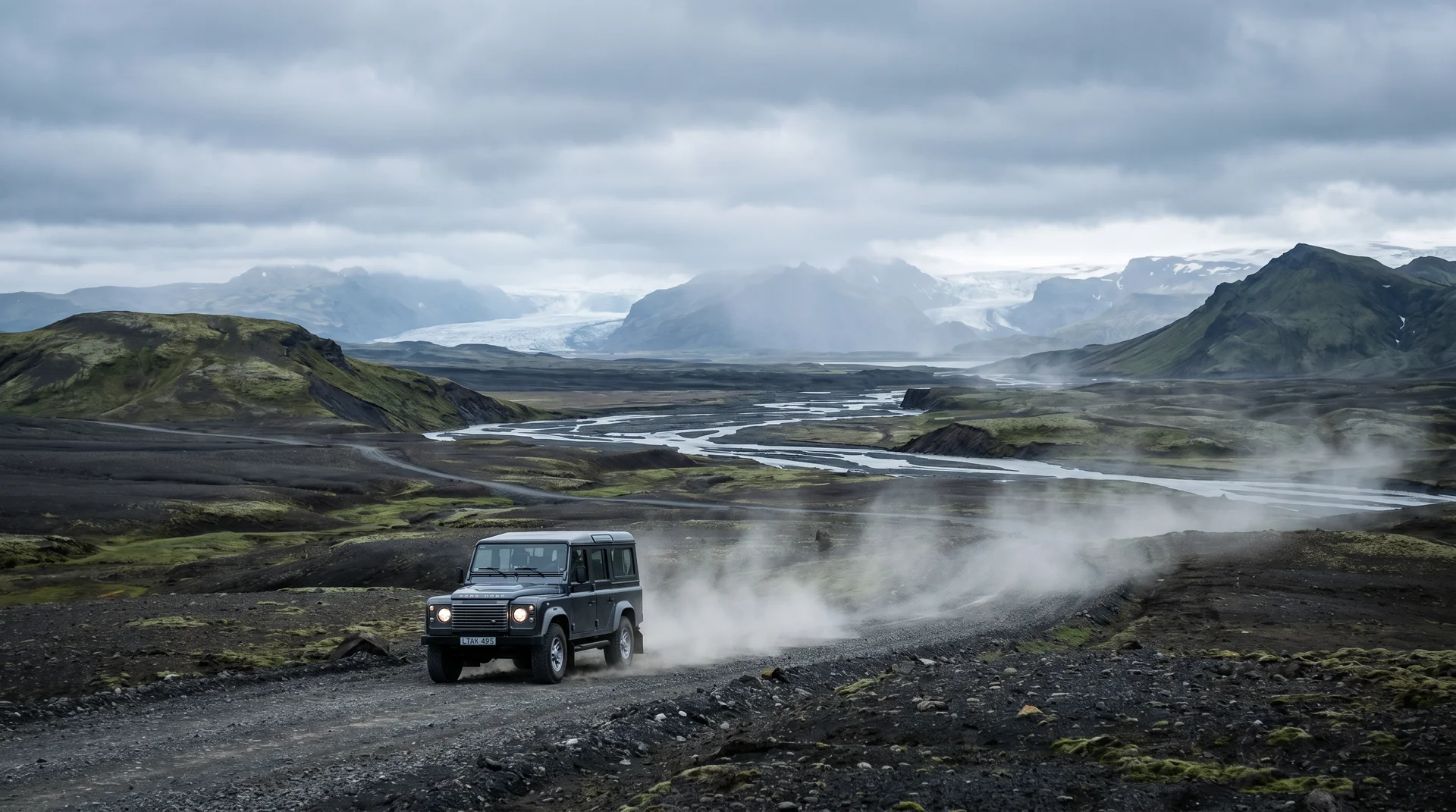
Driving the F-roads, slowly.
On the F26, somewhere between the second river crossing and the third, you stop trying to read the road as a road.
It is washboard gravel for two hundred kilometres. There are no fences, no road signs other than the markers, no oncoming traffic for hours. You are reading the surface: the colour of the gravel, whether the small stones are wet or dry, whether the next river is the size you expected from the map or twice as wide.
Iceland's Highland roads are not, despite the maps making them look like roads, roads. They are routes. The distinction is not pedantic. A road implies maintenance, signage, an expectation of passage. A route is a suggestion the country is making about where it is possible to drive. The suggestion changes by the hour.
A road implies maintenance, signage, an expectation of passage. A route is a suggestion the country is making about where it is possible to drive.
Reading the surface
Washboard is the default, and it has a speed at which it stops hammering the car. Finding that speed is the first thing the Highlands teach you, and the lesson is a trap. Too slow and every ridge goes through the suspension individually. Slightly faster and the tyres begin skimming the tops, the noise smooths out, and the ride feels like a reward. It is not a reward. The car is riding on the crests of the corrugations and steering has become a suggestion.
Loose gravel on a bend behaves like a liquid. You brake before the bend rather than in it, you steer with the throttle closed and your hands calm, and if the back of the car moves you look where you want to go instead of at the thing frightening you. None of this is exotic driving technique. It is the ordinary stuff that people forget the moment the surface changes under them.
Wet gravel is better than dry gravel for grip and worse for everything else, because wet gravel means the rivers are up.
Reading water
A ford is not a puddle, and it is not a decision you can make from the driver's seat. If you cannot see the bottom, or you cannot pick out the exit line on the far bank, or the water is moving faster than a person walks, you get out and look at it. Sometimes that means wading it, in glacial meltwater, which is miserable and unglamorous and takes five minutes and is the entire safety margin.
You cross where the river is widest, because wide means shallow and slow. You angle downstream rather than driving straight across, so the current pushes the car along its line instead of into its side. You enter slowly and keep going at one steady speed, no gear changes in the water, no stopping halfway to look at anything.
And you cross early in the day. Glacial rivers are fed by melt, melt is fed by sun and warmth, and a river you walked through after breakfast can be a different proposition by late afternoon. Same river, same crossing point, same car. The mistake is thinking of a ford as a fixed obstacle you have already solved once.
If it is too much, it is too much, and there is no version of this where being wrong about that is cheap. A drowned engine in the Highlands is not a bad afternoon. It is a recovery vehicle from a long way away, an insurance conversation that will not go your way, and a hole in the middle of your trip.
One more thing, learned from other people rather than from any cleverness of mine: do not follow a track into water because tyre marks go in there. Tyre marks going in prove that a vehicle went in. They tell you nothing whatsoever about the far bank.
Why the Super-Jeep exists
I had been smug about choosing the 4×4 over the larger Super-Jeep. By the second river, clear water, fast current, indeterminate depth, I was less smug. I waited forty minutes for a Toyota Land Cruiser to come the other way, watched its line, and copied it precisely. The water was halfway up the doors. The cabin stayed dry. Nothing was wrong; nothing felt wrong; this was just what the F-road wanted from me.
Waiting to watch somebody else's line is not a technique anyone teaches, and it was the single most useful thing I did all week. A local vehicle taking a crossing tells you the depth, the entry point, the exit point and the angle, all at once, for nothing. If nobody comes, you have learned something else, which is how alone you are out there.
The larger vehicle is not about bravado. It is ground clearance, and a snorkel, and the ability to be wrong by a foot of water without that being the end of the trip. What you are buying, if you hire one, is margin. Whether you need margin depends on the route, the week, and the honesty of your own self-assessment, and the rental desk cannot make that judgement on your behalf.
Markers, crests, and meeting someone
Navigation out here is by marker post and by paying attention, and the posts matter most in exactly the conditions where you can least see them. Fog comes down over the interior quickly and takes the horizon with it, and with no horizon there is no way to tell a rise from a dip. On a bad afternoon you drive from one post to the next and you do not leave one until you have found the following one.
Blind crests are the other thing. A track that has been empty for two hours is still not empty, and the moment you begin assuming it is, is the moment another vehicle appears over a rise in the middle of the only usable line. Crest slowly and on your own side. It costs seconds, and there is nothing out here that you are late for.
Meeting somebody becomes an event rather than an inconvenience. People slow right down, people lift a hand off the wheel, and if either vehicle is stopped the other one asks. That last part is not politeness. It is the working assumption that the nearest help available is you.
What the gravel does to a car
Stones come off the tyres of anything you pass and hit the windscreen, the headlights, and the paint along the sills. Take the gravel protection when the rental desk offers it. Slow down when you meet another vehicle, both of you, which is the local custom and also the only thing that works. Hang back behind anything moving, not for braking distance but because you are driving through the stones it is throwing at you.
Check the spare before you leave tarmac. Look at it physically, find the jack and the brace, confirm they exist and that you know how they work. There is no shoulder to wait on out here, phone signal is something you should assume you do not have, and a puncture in the Highlands is either fifteen minutes of work or the end of the day, depending entirely on a check you did or did not do in a car park in town.
Patience is the skill
The lesson, which is easy to articulate and harder to absorb, is that speed is the wrong variable. The F-roads reward patience the way that bouldering rewards balance. Five kilometres an hour at the right line is faster than forty at the wrong one.
Everything about a Highland day argues for building it long and empty. Distances that would be an hour on tarmac are half a day. The route you planned is a hypothesis, and the country will tell you at the second river whether the hypothesis survives. If it does not, turning round is not a failed day. It is the day working correctly.
By the end of the week I had stopped estimating arrival times, which felt like giving something up and was the point. You do not drive the F-roads in order to get somewhere. You drive them because the driving is the thing, and it asks for a kind of attention that ordinary roads have persuaded most of us we no longer have.