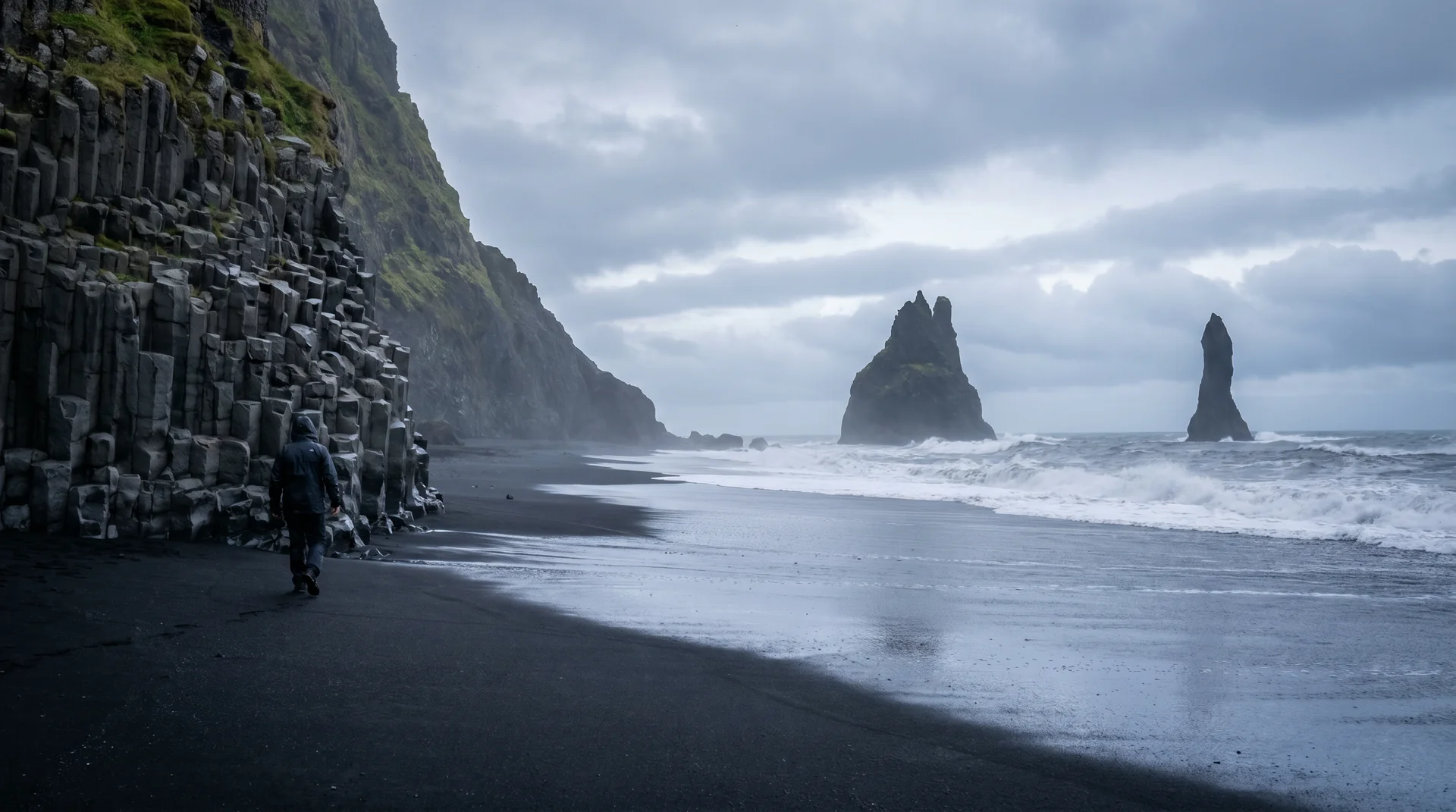
On the black sand coast, after rain.
There is a particular silence on the south coast in the hour after a storm, the kind that makes you think the country has briefly held its breath.
The road from Vík was empty. Spray off the Atlantic had filmed the windscreen with salt and the wipers couldn't quite catch it. I stopped at a pullout I had not planned to stop at, because the light had turned that specific Icelandic colour that has no English name: somewhere between graphite and pewter, with a thread of green underneath.
Out on the sand, two ravens. A line of basalt columns. The wind, briefly, dropping.
This is what the maps cannot tell you. They can show distance, elevation, the location of a fuel pump. They cannot show you the moment, on day six, when you realise you have stopped checking the time. The country has taken over the schedule. You are reading weather instead of clocks.
What black sand does to light
Black sand does not behave like sand. Pale sand throws light back at you and fills in the shadows under everything standing on it. Ground basalt absorbs. On a bright day the beach reads as a hole cut into the middle of the view, your eyes keep adjusting for it, and your photographs come back a stop darker than the scene looked. On a flat overcast day the effect runs the other way and everything collapses into three grades of the same grey: sea, sky, sand, with the foam line the only legible thing anywhere.
Wet sand mirrors. That is most of what people are photographing when they photograph this coast, the thin retreating film of water that turns the beach into a black glass floor with a sky in it. It lasts a few seconds after each wave. Dry sand a metre higher up is matte and dead and takes the fingerprints of the wind, small ridged patterns that reform every few minutes while you watch.
It is heavier than beach sand elsewhere, and it goes everywhere and stays. In zips. In the seams of a camera bag. In the footwell of the car for the rest of the trip, so that you are still finding it weeks after you have flown home. When the wind gets up it rattles against the side of the car like dry rain, and against bare skin it stings enough that you turn your face away without deciding to.
The water is not scenery
Everyone tells you about the waves here and it does not land until you have watched a set for ten minutes. Twenty waves stop at roughly the same line. The twenty-first comes a long way further up the slope with no warning and no visible difference on its way in. If you were standing at what looked like a safe distance you are now in water to the knee on a steep beach, and the water that came up is going back down, and it is taking the sand out from under your boots as it goes.
The trap is not carelessness. It is attention. You set up a tripod, you put your eye to the viewfinder, you crouch to get the reflection you came for, and you have just handed over the only sense that was watching the sea. Every close call I know of happened to someone who was concentrating.
The trap is not carelessness. It is attention. Every close call I know of happened to someone who was concentrating.
So you stand above the highest wet line rather than on it, you keep your body turned so the water stays in the corner of your vision, and you accept that this costs you the composition you had in mind. The signs at these beaches are not decoration and they are not the country being nervous on your behalf.
Everyone else is also here
The famous stretches of this coast are not a wilderness experience and it would be dishonest to write them as one. There is a version of this beach with a car park full of coaches and a version with three cars in it, and what separates them is not the season and not luck. It is the hour.
The hour is early, or it is late, or it is during weather that other people have decided is unacceptable. That last one is the cheapest of the three and the most reliable. Rain that would end a beach day anywhere else is an ordinary Tuesday here, the light under a broken storm sky beats anything you will get at midday, and most of the coaches will already have moved on to the next stop on a fixed list.
I am not romanticising discomfort. Standing in wind-driven rain is unpleasant and I did not enjoy the first twenty minutes of it. But the coast is not withholding anything from you at those times. It is the other way around.
A note on rhythm
The locals I spoke to in Höfn that week said the same thing in four different ways: don't fight the day. If the wind is up, stay. If the sky breaks, drive. The trip is the negotiation.
It sounds like a pleasant sentiment until you price it. Not fighting the day means you will lose things. You will lose the beach you drove three hours for. You will spend a morning in a car park watching horizontal rain, drinking coffee out of a thermos, reading the same page of a book four times, and the thing you had planned for that morning will simply not happen on this trip and possibly not in your life.
What you get in exchange is that when the sky does break, you are already there. That is the whole trade. The people who get the extraordinary hour on this coast are not luckier than you. They were parked nearby with nothing scheduled, and they were still there in the late afternoon when everyone who had a plan had already left for the next item on the list.
The practical version, which I now use everywhere: build the day with one anchor and three maybes. One thing you will do if the weather allows anything at all, and three things you would be pleased to reach. Never two anchors. Two anchors is a schedule, and a schedule is the thing you will start defending against the evidence in front of you.
Small violence, mostly to the car
Wind takes car doors off here. Not metaphorically. You open the door on the sheltered side when you have the choice, you hold it with both hands going out and coming back in, and you never let a passenger swing one open into a gust, because the hinge is the only thing stopping it and the hinge loses. It is the most boring paragraph in this piece and it is the one that will save you the most money.
Salt is the other one. An hour near breaking surf puts a film on everything: windscreen, headlights, lens, the front element of a phone camera you did not think to protect. A lens cloth in a jacket pocket, rather than in the bag in the boot, is the difference between wiping every few minutes and giving up. Rinse the tripod legs when you get back. Sand in the leg locks is how tripods die.
Gloves you can work a camera in are worth more than warm gloves you cannot, because you will take the warm ones off, and once your hands are wet and cold on this coast the day has quietly ended whether or not you admit it for another hour.
Leaving
The light went the way it goes here, not with a sunset but with the colour draining out of the middle distance until the basalt and the sea were the same value and only the foam was still readable. The ravens had gone. The wind came back up as though it had been waiting politely for me to finish.
I sat in the car with the heater on my hands and watched the salt rebuild itself on the glass, and it occurred to me that I had been at that pullout for two hours and had not once wondered what time it was. That is the thing this coast does. It is the reason to come back and it is completely useless as a recommendation, because you cannot plan for it. You can only leave enough room in the day for it to happen to you.